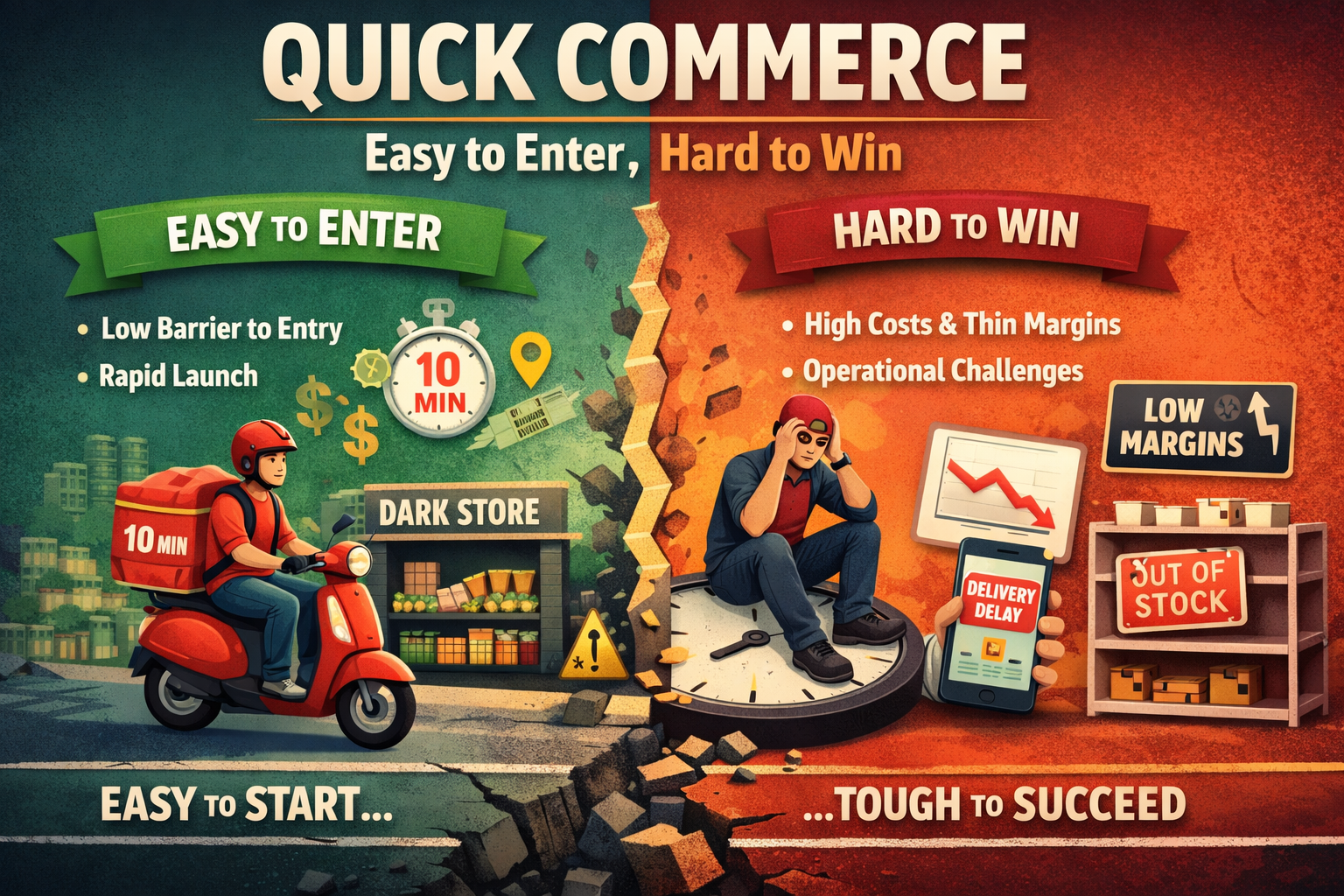
It’s late at night. You’re out of milk, snacks, or something you suddenly need.
Ten minutes later, the doorbell rings.
That simple moment captures how quick commerce (q-commerce) has become an everyday habit for Indian consumers not a luxury, but a default.
From Convenience to Habit
India’s grocery market is expected to reach ₹78 lakh crore by 2029, but the real shift is happening inside it.
Quick commerce is set to triple by 2027, growing to ₹1.5–1.7 lakh crore. What started in metros is now expanding into Tier-1 and Tier-2 cities, especially among households earning ₹6 lakh+ annually.
People aren’t choosing q-commerce for discounts. They’re choosing it for time, ease, and certainty. Once experienced, it sticks—platform preference among frequent users jumps from 33% to 87%.
What People Buy in “Just Now” Moments
Q-commerce fills the gaps between planned shopping trips.
About 6–8% of sales are incremental, driven by impulse needs—snacks, chocolates, beverages, ice creams, and quick essentials. Pricing plays a role, but convenience wins. Discounts are modest and comparable to local stores.
For brands, these impulse moments are where visibility, packaging, and availability matter most.
What This Means for Brands
Quick commerce is no longer a side channel. It’s where discovery, repeat purchases, and even premium launches happen—especially in food, personal care, gifting, and home categories.
But success here needs speed, focus, and the right execution.
Where BrandPort.in Comes In
BrandPort.in helps brands launch and scale across general trade, modern trade, and quick commerce—including platforms like Blinkit, Zepto, and Swiggy Instamart, JIO Mart.
With presence across 25 Indian cities and work across 5 countries, BrandPort.in helps brands move faster, choose the right SKUs, and win in high-intent moments. Over 200 D2C brands have already made this shift in the past two years.
The Bigger Picture
Quick commerce isn’t replacing retail—it’s completing it.
As consumer expectations evolve, brands that embrace speed and convenience early will build stronger, more relevant connections.
In a world where delivery takes minutes, waiting is the only real risk.